

Can’t We All Get Along? Testing a Trust-and-Cooperation Neighborhood Model for Multi-Project Delivery
BACKGROUND
Across many industries, traditional project delivery mechanisms encourage competitive, siloed behavior, rather than collaborative, cooperative behavior. The result: traditional mechanisms often yield inefficiencies, frustration, and wasted time, money and materials.
In the construction industry, for example, current approaches such as “lowest bid wins” do not promote trust or collective responsibility among actors. The result: the loss of time and money, and, often a “blame culture” that focuses attention on placing blame when problems arise rather than collaboratively seeking solutions. In health care, fragmented care across multiple providers results in inconsistent treatment and delays as well as communication failures that can result in patient frustration and medical errors. We see similar dynamics in manufacturing supply chains and software development.
A BETTER WAY TO DO BUSINESS?
The Bureau of Business Research posed a fundamental question: Is there a better way to do business? Might a more cooperative model — especially one that is formalized upfront and repeated across multiple projects — yield better project outcomes, great satisfaction, lower costs? To test this idea, researchers focused their attention on the construction industry. Through a survey of industry participants and a series of workshops, researchers have explored the willingness of the construction industry to engage in a new behavioral model and have examined how that model could play out in an actual construction project. The research was funded by the Construction Industry Institute.
THE NEIGHBORHOOD MODEL, EXPLAINED
The neighborhood model of cooperation offers an alternative way to conduct business — one that emphasizes shared values, open communication and more equal distribution or risk and reward. Use of the neighborhood model demands that participants commit to a number of key principles:
- Integrated, joint management of a project among all key contributors (owner, contractor, architect, subs, etc.)
- Fair risk management and risk/reward sharing
- A commitment to no disputes
- Decision-making that focuses on project outcomes and adding value
- A no fault / no blame culture
- Full transparency and accountability
- Clear project KPIs
- Mutual trust and respect
- Open communication and information sharing
Note that the neighborhood model of cooperation implies a multi-project scope. Just as with a physical neighborhood, where residents live for many years and build trust across fences, hedges and driveways, the model suggests that trust builds over time as actors come together to tackle multiple projects. This means that firms don’t need to maximize the profits they receive from each individual job; instead, they can count on continued collaboration with a known set of actors and a steady stream of work — factors which encourage a long-term view of success.
METHODS
The study comprises two phases of investigation
- A survey (conducted in 2021) to assess the construction industry’s readiness and willingness to adopt a collaborative framework and identify potential areas of resistance.
- A series of three co-design workshops (conducted in 2024) with a construction industry partners and a fourth workshop with construction lawyers. The goal of the workshops was to rigorously test the Neighborhood model. Each workshop was structured to facilitate open dialogue, collaborative exercises and scenario-based discussions that replicated real-world challenges in construction project delivery.
FINDINGS
Survey and workshops revealed that the neighborhood model of cooperation is appealing. The model creates a standardized working experience that fosters smoother collaboration and more predictable frameworks for project execution.
- Appeals of the Neighborhood Model. The model’s appeal stems from the promise of consistent work, the formalization of successful relationships, its compatibility with existing contracting structures, and the financial benefits of transparency. Participants also valued the ability to codesign the model’s governing principles to suit their needs.
- Concerns about the Neighborhood Model. Concerns included the potential for the model to be exclusionary, difficulties in quantifying cost savings, the reluctance of some firms to take on additional risk, and the challenges of ensuring consistent personnel work on projects.
- Essential Features for Implementation. For successful implementation, participants noted the importance of having a project scale of at least $10 million, pre-existing working relationships, the involvement of insurance carriers, and the co-design of the framework by all parties.
- Traditional Project Challenges. The model aims to address challenges prevalent in traditional approaches, such as a “blame culture,” inflexible owners, and a lack of proper budgeting for project contingencies.
- Contractual Elements. Legal professionals emphasized key contractual elements needed for the framework, such as provisions against refunding lawyer fees, financial thresholds for litigation, and the use of third-party risk mitigation tools like Owner-Controlled Insurance Programs (OCIP) and Contractor-Controlled Insurance Programs (CCIP).
- Crosscutting Themes. The workshops also highlighted the importance of iterative learning, open communication, and the use of a cooperative ‘hub’ structure to drive success.
FUTURE APPLICATIONS
Though researchers used the construction industry as a “test case”, the neighborhood model could be applied to other complex operational environments requiring trust and coordination among multiple stakeholders. The model has the potential to transform health care, manufacturing supply chains and technology development.
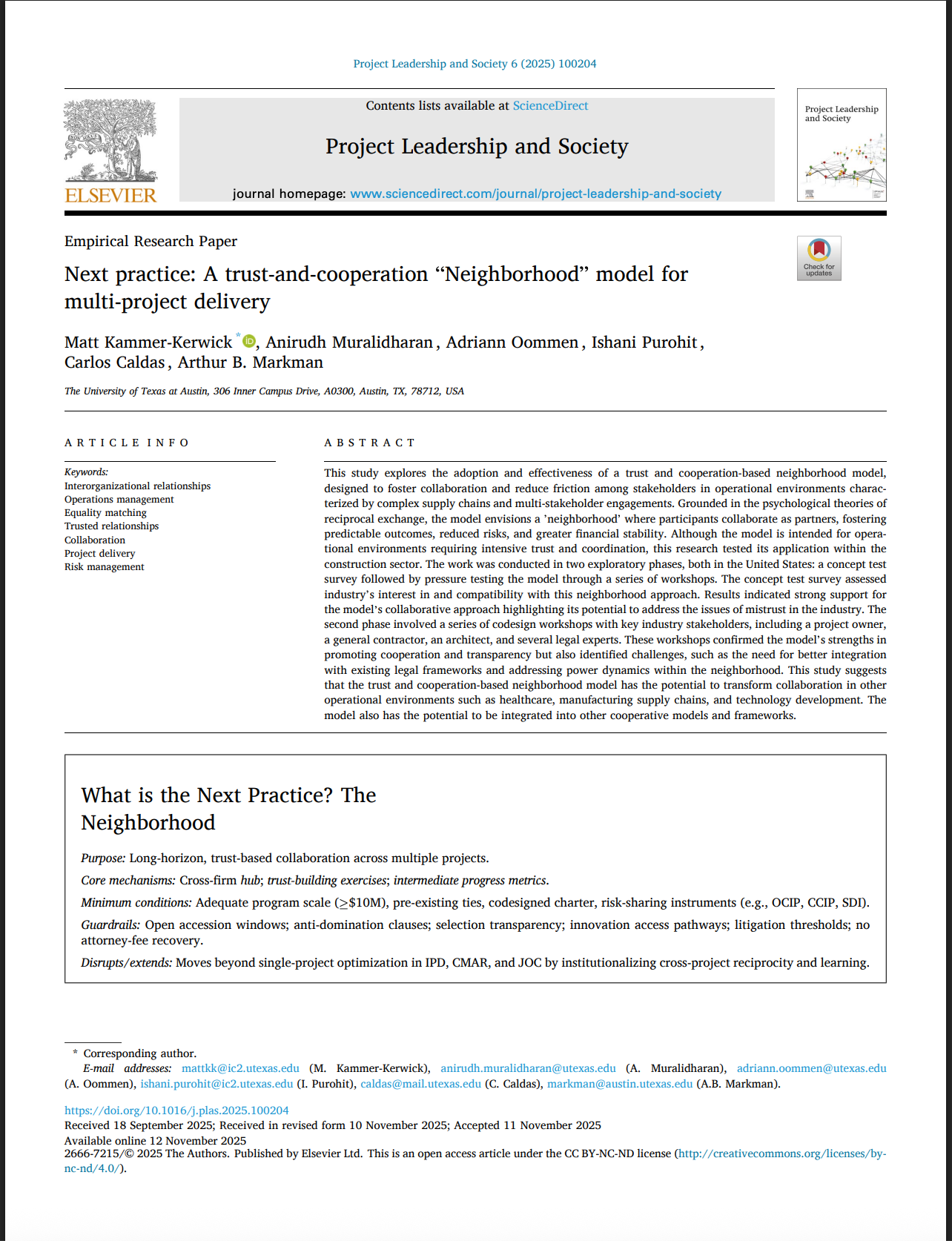
Next Practice: A Trust-and-Cooperation Neighborhood Model for Multi-Project Delivery
journal article