

BACKGROUND: A DECADE OF RESEARCH ON EXPLOITATION
For over a decade, the Bureau of Business Research (BBR) has been developing a line of research on the economic and social impact of human trafficking and other forms of exploitation. From benchmarking the extent of human trafficking in Texas, to designing interventions to stem wage theft, BBR researchers have pushed the scholarly boundaries of research into exploitative behaviors.
In recent years, BBR has focused not only on understanding the dynamics of exploitation but also on leveraging data science and decision science to design and test interventions — with the ultimate goal of reducing exploitative behaviors.
TEXAS HUMAN TRAFFICKING MAPPING PROJECT
 In 2016, the Texas Office of the Governor funded a study examining the prevalence and economic impact of human trafficking in Texas. The Bureau of Business Research partnered with the Institute of Domestic Violence and Sexual Assault (IDVSA) to conduct the study. The resulting report, Human Trafficking by the Numbers, revealed startling statistics: In 2016, there were approximately 313,000 victims of human trafficking in Texas and 79,000 were minors. There were 234,000 victims of labor trafficking. Researchers found that minor and youth sex trafficking costs the state approximately $6.6 billion.
CHILD SEX TRAFFICKING: “TO THE PUBLIC, NOTHING WAS WRONG WITH ME”
In 2019, BBR researchers, again in partnership with IDVSA, undertook a study to understand child sex trafficking. The researchers focused on three Texas regions – Houston, Lubbock and the Texas-Mexico border. The resulting report, “‘To the Public, Nothing Was Wrong With Me’: Life Experiences of Minors and Youth in Texas at Risk for Commercial Sexual Exploitation” explores the life experiences of young adults and minors, ages 13-27, who are survivors of child sex trafficking. The study examines specific experiences of minor and youth survivors, including risk factors, push/pull factors, help-seeking behaviors, and reasons for multiple exits and re-entries into trafficking.
LABOR EXPLOITATION IN THE FISHING INDUSTRY
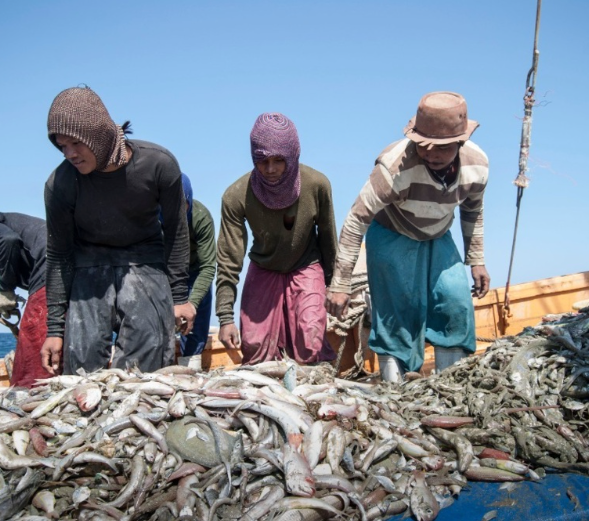
Photo Credit: Environmental Justice Foundation
Building on their understanding of exploitative behaviors, BBR researchers and other colleagues extended their research to an exploration of labor exploitation in the Thai fishing industry. Research focused on trafficked and forced labor and explored the complex interplay of economics and environmental factors.
Using a system dynamics model, the resulting study presents an explanation of how an emphasis on one policy over another impacts key metrics by providing results that are counterintuitive and highlight the need to consider the whole process – for example allocating a large portion of a budget towards awareness campaigns reduces fish stocks and over time forced labor increases. The research reveals that in order to be effective and minimize unintended consequences, policies must be combined and implemented dynamically. View the resulting journal article: ‘Fishy’ banks: Using system dynamics to evaluate policy interventions for reducing labor exploitation in the seafood industry.
EXAMINING THE ILLEGAL WILDLIFE TRADE IN SOUTH AFRICA
BBR Director Matt Kammer-Kerwick joined an interdisciplinary team examining the illegal wildlife trade around Kruger National Park, at the intersection of Mozambique, Zimbabwe and South Africa. With several game parks dominating this region, the clustering of villages inside and outside the park borders create a complicated maze of ownership, territoriality and predatory behavior. Led by the University of Maryland’s Meredith Gore, the research team worked to understand links among the illegal wildlife trade, traditional medicine, zoonotic diseases, and wildlife conservation. Their research centered on an indaba, a traditional African method for decision-making. The researcher-hosted indaba helped the team advance knowledge about other appropriate research methodologies and possible interventions. View the resulting journal article: Opportunities for Transdisciplinary Science to Mitigate Biosecurity Risks From the Intersectionality of Illegal Wildlife Trade with Emerging Zoonotic Pathogens.
ADDRESSING WAGE THEFT IN THE DAY LABORER COMMUNITY
Many day laborers experience some form of exploitation at the hands of their employers; often that exploitation comes in the form of wage theft. BBR researchers have been examining wage theft since 2016, when they began interviewing day laborers in Houston and Austin. When continued on-the-ground research proved difficult, the team turned to computer simulations to understand the laborer/employer dynamic. Their latest research, funded by the National Science Foundation, uses an AI-based reinforcement learning model to build a framework to test hypothetical wage theft interventions. The model-based framework could help policymakers and workers prevent and respond to wage theft. View the resulting journal article: Reinforcement learning to develop policies for fair and productive employment: A case study on wage theft within the day-laborer community.
STUDENT RESEARCHERS / OTHER RESEARCH PARTNERS
In addition to Matt Kammer-Kerwick and Bruce Kellison, a number of students and other research partners contributed to the studies referenced on this page:
- Human Trafficking – Noel Busch-Armendariz; McKenna Talley; Melissa I.M. Torres; John Nehme; Laurie Cook-Heffron; Nicole Nale
- Fishing Industry – Renata A. Konrad; Khalid Saeed; Palawat Busaranuvong; Wai Khumwang
- Illegal Wildlife Trade – A. Alonso Aguirre; Meredith Gore; Kevin M. Curtin; Andries Heyns; Wolfgang Preiser; Louise I. Shelley
- Wage Theft – Evan Aldrich; Mayra Yundt-Pacheco; Nayan Vashisht; Kara Takasaki; Noel Busch-Armendariz; McKenna Talley; Melissa I.M. Torres
RELATED CONTENT
New Research Uses AI Reinforcement Learning to Address Exploitation of Day Laborers
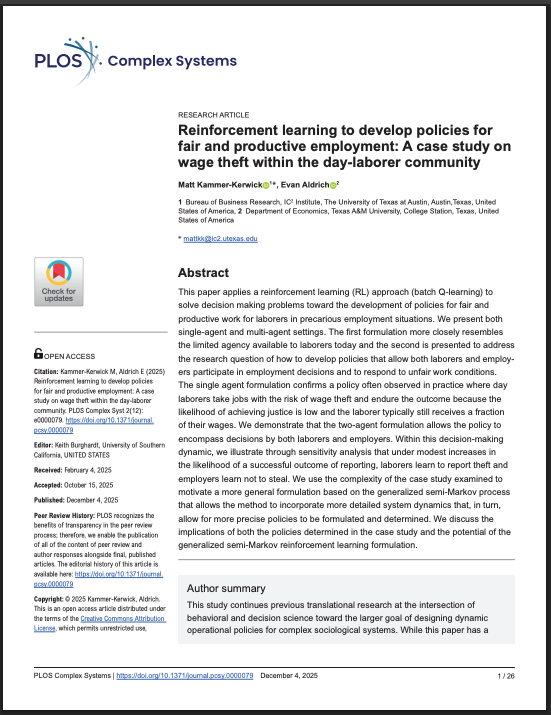
Reinforcement learning to develop policies for fair and productive employment: A case study on wage theft within the day-laborer community
journal article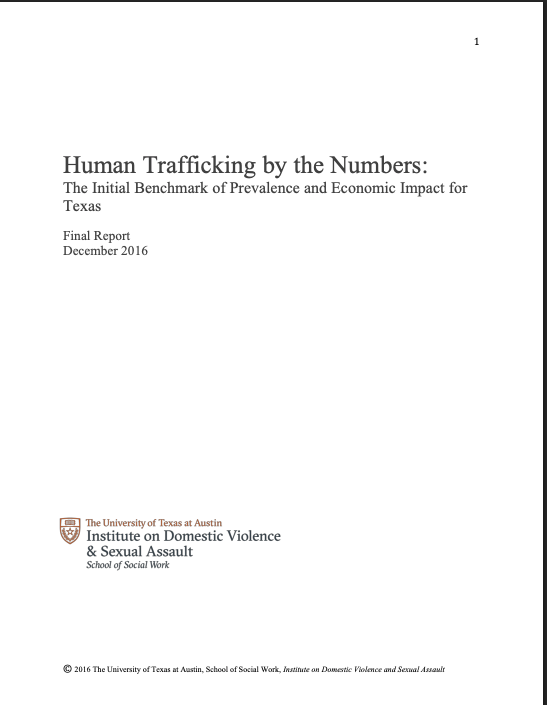
Human Trafficking by the Numbers: The Initial Benchmark of Prevalence and Economic Impact for Texas
report