

Published September 14, 2026
Michigan native and former college soccer player, Luke McDonald, is beginning his second year as a Ph.D. student in economics. Luke works as a graduate research assistant for the Bureau of Business Research (BBR) at the IC² Institute. In his two years with the BBR, Luke has proven himself to be an agile researcher, deftly moving between varied projects.
BBR Director, Matt Kammer-Kerwick, said, “I’m especially excited that Luke is now in a position to pursue a research agenda of his own design, one that aligns with our shared goal of advancing societal well-being through data, modeling, and evidence-based policy exploration. His emerging work on climate resilience reflects both his intellectual curiosity and his commitment to addressing complex societal challenges.”
We caught up with Luke in July (in between World Cup matches) and asked him a few questions about economics, agent-based modeling and sandwich preferences.
Note: This interview has been lightly edited for readability.
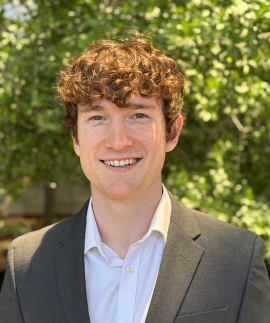
Luke’s first job was as a volunteer soccer coach. His dream job? Economics professor and owner of a board game coffee shop.
How/when did you discover that economics is your thing?
My high school in Michigan offered AP micro and macro [economics], so I got exposure then, which was great. I’ve always been very math oriented, but I’m more interested in social justice issues than pure math. And so I think economics offers a good framework.
Within your economics Ph.D. program, have you declared a specialty?
Not yet — that usually happens in second year. But I’m leaning towards microeconomics, specifically in the realm of industrial organization or environmental economics.
Can you define environmental economics for us?
Things like energy or natural resource management — those are the types of questions that environmental economics would try to answer. Trying to make current systems more sustainable for the future, and [examining] the trade-off between present day consumption and future generation consumption.
What’s your dream job?
Being a professor, which would allow me to hopefully research things that I’m interested in while teaching. That would be an ideal fit. And outside of academia, I used to coach soccer — I would love to do that again. I would also love to open a board game coffee shop …
First job?
Volunteer soccer coach. But my first paying job was working at Panera Bread. I definitely made more in food than I did in money.
Tell us about your first assignment with the Bureau of Business Research – working on the Southwest I-Corps project.
That work was sponsored by NSF [National Science Foundation] and they were trying to get feedback from program participants to see what they thought of the ICorps training itself and how that helped them bring their technologies to market. They were asking participants about whether they had founded a company, if they required funding, the number of employees they had, etc. … And we were taking in that data, cleaning it, and then providing some suggestions to help I-Corps improve the program. That was a great initial project for me because I had done some data cleaning and wrangling in my previous job but had not done any of the analysis, and this was a very basic analysis task that still pushed me a little further down the work pipeline. It was great to kind of get my feet wet before diving into more complex projects.
Describe your next BBR assignment, working on the UTEACH Institute impact study.

Luke McDonald, Matt Kammer-Kerwick (right) and colleagues from University of Alabama presented their research at the Association for University Business and Economic Research conference last fall.
I would say this was my first proper project that I saw from start to finish. We were looking at the efficacy of UTeach and, as it was being implemented in Alabama, what they could expect their return on investment to be. A report and a conference presentation came out of that. Within the economics Ph.D. program, presenting your research normally happen much later, not until, I would say, third year or beyond. So being able to just get a feel for that, this early, was awesome.
What new project are you working on this summer?
The project is a flood insurance uptake model in Houston. This is part of Matt’s reinforcement learning, agent-based modeling methodology. The main focus of the project is essentially refining this methodology that Matt is putting together that combines concepts from a few different modeling approaches.
Can you explain agent-based modeling to us?
At a high level, agent-based modeling means you have individual persons within your model that are making decisions and interacting with other agents in the model — those might be the government or some local entities, some firms. And so the reinforcement learning piece is that those agents within the model get feedback from the interactions and then update how they behave within the model.
So how are you applying agent-based modeling to flood insurance?
We’re modeling how households choose whether or not to purchase federal flood insurance. First we’re trying to calibrate the model; essentially, make it mirror the real world as best as we can. And then we’re going to let the agents make decisions for themselves and see if we can find a better flood insurance policy for the government to offer households that might improve coverage. Or improve equity of coverage or, hopefully, if we were to stand the model up, reduce damage overall by allowing households to invest in mitigation, or perhaps move away from high-risk floods.
And how did you pick up modeling skills — in class or on the job?
On this job, for sure. Within my Ph.D. program, I’ve kind of learned the language which a lot of these methods use, but I haven’t had the hands-on experience creating them myself. I feel like UTeach was a simpler applied model, and now this [flood insurance project] is trying to be a more rigorous academic model. And so it’s been a nice ramp up, with Matt slowly giving me more and more range.
Matt [Kammer-Kerwick] hosts team meetings where BBR student researchers gather to discuss their projects — have those meetings impacted you?
Definitely. I learn a lot from everybody else in those settings — Matt picks smart and hard-working people. Just hearing people’s ideas of how to solve new problems is really interesting. Like on the ICorps project, there was a missing data issue … but another student, Milan [Raj], found an external source which allowed him to join additional data into what we already had. And so to see somebody else coming on our project that I’d been working on and just completely find a way to transform what we were doing, is super cool.
Well, yes, it’s cool, but you could easily feel defensive about someone else jumping into your project, right?
You can’t be defensive, and maybe that’s something that I learned through playing sports. At the end of the day, you’re trying to get better as a team. We learn together and that just makes everybody around you better.
If you were describing the Bureau of Business Research to a friend, how would you describe what they do?
I think BBR has so much breadth in the topics that it’s willing to cover. But I think the common thread is staying true to the mission of trying to help improve the well-being of the world. Whether it is improving a science technology research program, or a teacher training program, or flood insurance, the general focus is to try and improve systems that interact with people on a day-to-day basis. And hopefully those little incremental impacts make the community better.
Has working for BBR helped you figure out your career path?
It’s definitely giving me a taste for different flavors of research. The I-Corps project was mostly working with summary statistics and basic analytics — we weren’t trying to say much beyond what happened with that data. And then the UTeach study was a very applied paper, in which we had to make a lot of assumptions. In order to be efficient with time and resources, you just have to make assumptions that allow you to say something … I really struggled with that at the start because I would say, “Well, how can we say what we’re saying?” But there still is use, I think, in gathering as much information as you can around the topic and then saying, “Okay, these are the gaps that we currently have.” And, in identifying those gaps, you can still get closer to an answer, and say, “If we can figure this out, and maybe somebody else could figure this piece out, then we can bring everything together and get a clearer picture of what the answer is.” And then finally, this flood insurance project is trying to be more closed and rigorous, but without a doubt, we will still have to make many assumptions.
As you reflect on the BBR projects and the “flavors” of research, what has been your favorite task so far?
I think the most fun I’ve had, and it may sound silly, is just reading about how flood insurance works in the United States. Because, you know, when I’m in class and I’m learning about micro theory, I’m effectively doing math problems and proofs, and it feels so far removed from the real world. Diving into a new topic that I really knew nothing about and having assumptions about how flood insurance ought to work and discovering that a lot of those things just may not be true, is eye-opening and allows me to understand the world around me better.
Last question, and, full transparency here: I have stolen it from Stephen Colbert’s “Questionert.” What’s your favorite sandwich?
Probably Tofurkey and cheese, with raspberry jam on it.
That’s pretty weird, isn’t it?
Yeah, but I’ve been eating a lot of it lately.
RELATED CONTENT
UTeach Program Creates Significant Economic Impact, BBR Study Finds