

 Uncategorized
Interdisciplinary research teams are improving disease detection and advancing AI tools using a human-centered approach.
Published June 16, 2026
In 2024, the IC² Institute partnered with Dell Medical School to fund interdisciplinary research teams working at the intersection of AI and health care. The funders issued a dual challenge: Improve patient outcomes and advance the ethical, responsible development of AI. As the cross-campus teams wrap up their funded research and pursue next steps, we’re pleased to share exciting results.
Defining Human-Centered AI
The researchers’ collective body of work represents not only technical advances in the development of diagnostic tools but also signals a growing imperative: AI that is human-centered. In fact, the projects deliver a compelling and achievable definition of human-centered AI that includes these elements:
- Guided by community input across all phases — design, deployment, governance.
- Incorporates human, lived experience — not just lab results.
- Facilitates physician/patient decision-making.
- Leverages human-AI teaming.
- Fits into existing clinical workflows.
- Built on datasets that reflect actual populations.
PROJECT 1: Developing Community-Informed AI Models for Improved Skin Cancer Diagnoses
Ruben Rathnasingham, former Assistant Dean for Health Product Innovation at Dell Med, led an interdisciplinary team seeking to improve skin cancer diagnosis in darker-skinned populations, a demographic for whom commercial AI models are notably less sensitive, with diagnostic performance gaps reaching 50%.
Creating Better Data Sets Using AI
The diagnostic performance gap has several root causes — chief among these is the lack of robustness in the image-based datasets used to train AI models. To address the gap in representative datasets, the research team developed its own pipeline to generate synthetic data. Their approach to creating synthetic data combined generative AI techniques with computer-generated imagery. According to Rathnasingham, the synthetic images have achieved high realism ratings from dermatologists and, importantly, the images successfully capture many of the quality variations typical of photos taken in primary care.
Placing Community at the Center of AI Development
One of the most notable aspects of the team’s work is the model they created for effective community governance of AI. The project team placed community involvement at the core of building its AI model by including over 60 individuals in its development. In doing so, the project treats community members not merely as end users of AI tools, but as co-creators, co-governors. This not only enhances the quality of AI development; it also addresses some of the trust issues that fuel the public’s skepticism of AI.
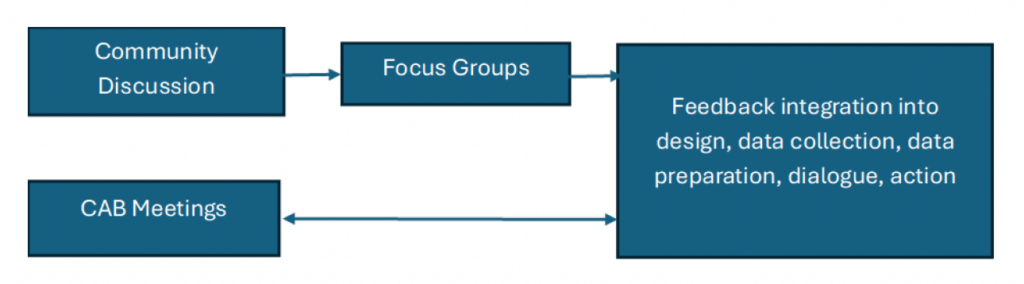
A specially formed Community Advisory Board met regularly to co-create performance priorities and deployment practices. For example, the community advisors defined “fairness” not as general statistical fairness, but as the equal probability of having a condition detected for every patient. They also called for simple language from AI outputs, preferring language such as “The AI is not confident about this result — specialist review is recommended” over confusing probabalistic scores.
Real-World Application: A template for sustained community involvement
According to Rathnasingham, the community engagement model, which emphasizes long-term partnership over one-time consultation, demonstrates that “ethical AI is not a destination but an ongoing process of partnership, accountability and adaptation.” The repeatable, scalable community advisory board model provides a proven template for incorporating community participation into technology oversight across a variety of health settings. In their final report, the research team stated, “The approach, evidence, and governance process documented here provide a template for responsible, equitable, and scalable AI across all specialties, with the potential for global impact as the field transitions toward participatory, community-owned solutions.”
PROJECT 2: Leveraging Machine Learning to Identify Adolescents’ Risk of High Blood Pressure

Early identification of hypertension risk (and appropriate interventions) can substantially improve long-term cardiovascular and brain health.
Researchers Augusto Cesar Ferreira De Moraes (UT Health Houston School of Public Health in Austin) and Jack Virostko (Dell Med) sought to understand the non-medical drivers of health contributing to hypertension (high blood pressure) in adolescents and to develop an AI-driven hypertension screening tool.
According to the researchers, adolescence is a key developmental window in which early identification of hypertension risk (and prescription of modifying behaviors) can substantially improve long-term cardiovascular and brain health.
The ultimate goal of the research is for the medical community to be able to identify high-risk children before the clinical manifestation shows up — that is, while there is still time for interventions. This represents one of the great promises of AI in medicine: the prevention of disease.
The Need for a Better Predictive Model
Current pediatric hypertension risk prediction models have inherent limitations, particularly as they affect less advantaged communities. The existing models rely heavily on clinical measures such as blood tests and neuroimaging; this means that kids from lower-income households may not be able to afford and access the screening tools. It also means that those kids are not in the datasets driving the development of future models. Further, the models fail to account for non-medical drivers of hypertension — things like living conditions, geography and lifestyle.
Leveraging Machine Learning
To address these gaps, the researchers developed their own machine learning pipeline. To understand the interplay of non-medical drivers on hypertension risk, the researchers tapped data from the ABCD study, a long-term, National Institutes of Health-funded study following nearly 12,000 children from late childhood into adulthood. The researchers analyzed a wide range of health determinants, including physical measurements, daily habits, psychosocial elements, and environmental factors.
The resulting AI model points to a handful of factors as the most influential in driving hypertension in adolescents:
- Biological sex (being male is the strongest predictor)
- Abdominal obesity.
- Poor sleep quality
- Three crucial non-medical drivers of health (lower family income, reported exposure to perceived social stressors, and lower levels of parental education.)
Real-World Application: New Screening Tools
Building on their initial work developing the hypertension predictive model, the researchers are now developing a web-based app that will allow clinicians to input patient data (including lifestyle factors) and receive an instant hypertension risk assessment for that patient. The app will use “explainable AI” to show, visually, exactly which factors are driving a child’s specific risk.
Explainable AI refers to a set of methods that allows human users to comprehend and trust the outputs generated by machine learning algorithms. Why is this important? Virostko said, “High prediction accuracy alone is insufficient for clinical adoption. Explainable AI provides the transparency needed for clinicians and patients to understand, trust, and act on pediatric hypertension risk predictions.” In other words, the transparency that the researchers are building into their app will help doctors provide more targeted counseling and support shared decision-making between doctors and families.
PROJECT 3: Building AI-Driven Tools to Diagnose Colorectal Cancer
Roughly 30% of all colorectal polyps are precancerous growths, but the detection rate of these is suboptimal: ranging from 7-60%. Joga Ivatury, associate professor and chief of colorectal surgery at Dell Med is working with Farshid Alambeigi, associate professor of mechanical engineering, to improve detection rates. Their groundbreaking work combines robotic sensing, AI-driven medical imaging, and generative modeling.
Robotic Sensing
According to Ivatury, some AI detection tools already exist, but they identify adenomas (pre-cancerous polyps) that most doctors can already see. The UT team is trying to help doctors get at the smaller, more subtle adenomas.
Ivatury and Alambeigi have developed a tactile sensor, operated by an Xbox controller, that allows a physician performing a colonoscopy to “feel” the colon lining and potential polyps. The sensor will tell the physician whether the area is hard, soft, rough, smooth — and it will generate an image of the potential polyp.
Generating Synthetic Data
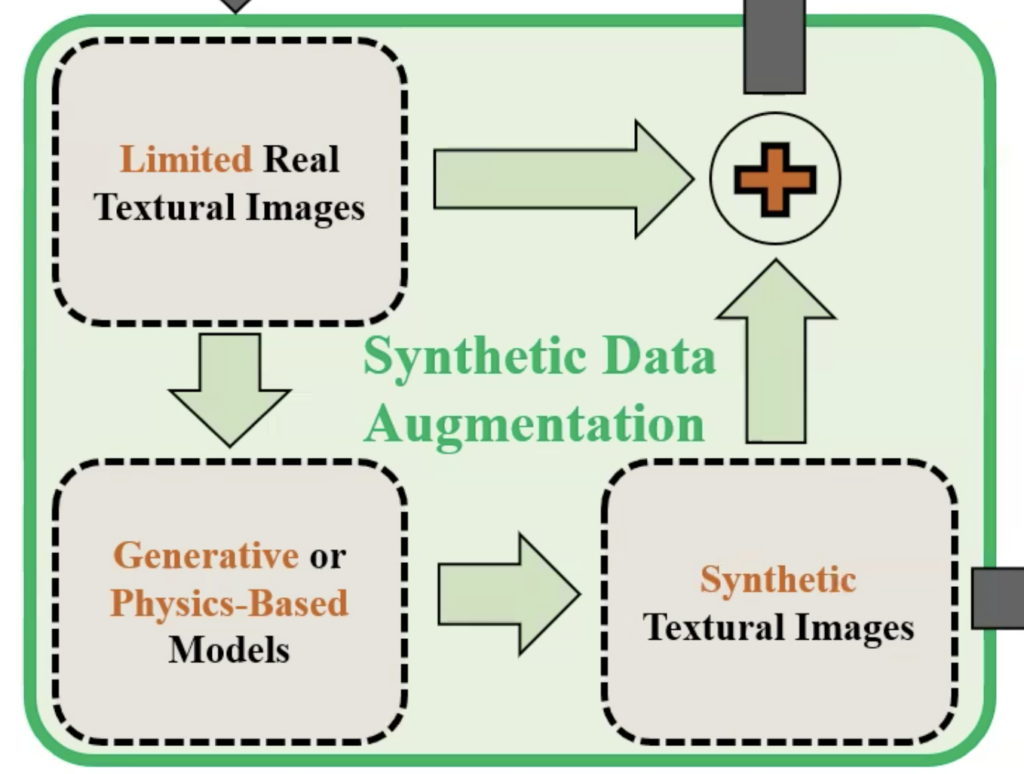
The researchers have taken real data and passed it though a generative AI model, which yields synthetic data.
In the case of colorectal disease detection, data skewed towards certain populations and polyp types can degrade the performance of AI models. If an AI algorithm is trained on too small a sample, for example, it will be more sensitive in detecting the most common types of polyps, making it more likely to miss rarer types.
The team used a diffusion-based generative AI model to create synthetic data; this synthetic data augments the real-world data. The researchers’ goal is to create synthetic images that are as realistic as actual images and as robust a data set as possible upon which to train the AI algorithm. They continue to refine the dataset using data from patients in Ivatury’s practice.
Real-World Application: A Smarter Colonoscopy
Ultimately, the sensor tool, working in concert with the specially created dataset, will help physicians during an actual colonoscopy by alerting them to a potentially suspicious spot. Augmenting the physicians’ perception but not disrupting colonoscopy workflow, the sensor will allow the physician to see and “feel” the spot and remove it if necessary. The enhanced detection capability should make colonoscopies less subjective and result in better detection of harder-to-discern polyps.
Alambeigi summed up the potential impact of their research: “Combined with AI trained on synthetic and clinical data, our tactile-sensing platform has the potential to improve the diagnosis of colorectal cancer and inflammatory bowel diseases while providing a clear path to FDA clearance and clinical adoption.”
Meaningful Outcomes
S. Craig Watkins, executive director of the IC² Institute, is thrilled with the research outcomes. As the teams drive their projects forward, each promises meaningful improvement in the delivery of health care through the use of human-centered AI.
“When you add up the results — one project demonstrating that sustained community input can effectively shape AI, another producing a screening tool that can incorporate a patient’s lived reality and be used to facilitate patient/physician decision-making, and another that promises better diagnosis of disease in a way that supports current physician workflow — this is the human-centered approach to AI that makes us feel hopeful about future applications of AI in medicine.” -S. Craig Watkins, IC² Institute Executive Director