

September 10, 2025
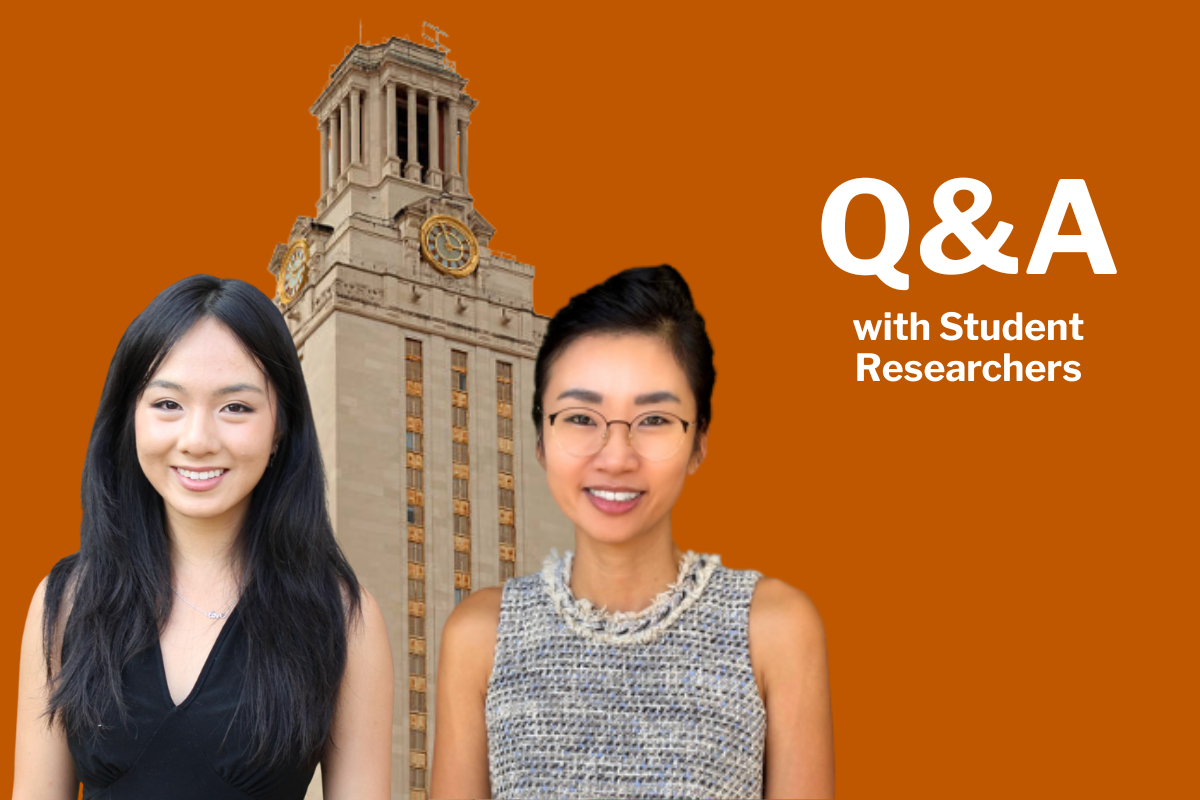
Tu-Quyen Dao, a senior biochemistry major, and Sookja Kang, a Ph.D. candidate in nursing science, spent the summer interviewing doctors who are at the leading edge of AI in health care. This fall, Dao and Kang are coding the interview transcripts to identify important and recurrent themes, with the goal of understanding how AI is reshaping doctors’ expertise and impacting patient care. The work is being guided by the project’s lead researchers, S. Craig Watkins, Matt Kammer-Kerwick, and Emily Spandikow.
We recently turned the tables on these Longhorn interviewers by asking them to field a few questions from us. Their responses, which have been lightly edited for readability, are early personal reflections — not final findings.
You have combed through dozens of hours of transcripts. What themes are most fascinating to you?
Tu-Quyen:
A key idea emerging for me is that with AI, you have all of these tools available, all these possibilities. But every doctor has mentioned what is uniquely human, whether it’s choosing when it is appropriate to engage AI, or being the hand to hold, you know, while the patient’s in distress, or being that source of comfort. I really enjoyed the story of Dr. X, who said the most meaningful thing he has ever done as a doctor was arranging a wedding for a cancer patient who was nearing the end of his life. I think this talk of ‘AI is taking over ‘doesn’t really resonate here. I feel like, as doctors, we still have that human quality that will always be important.
A few months into this work, are you more wary of AI’s dangers? Or more optimistic about its potential?
Sookja: I was skeptical of using AI in health care based on my understanding of how complex the system is and ethical-related issues. But these interviews have broadened my understanding of what tools are currently available, and how they could improve human clinicians’ efficiency, and possibly make health care more accessible to the broader population.
…During the conversation with a clinician from [a major medical center], we were stunned by how many AI tools they are actually implementing in their clinical practice, and how sophisticated they can be. … We always hear about how ‘AI is going to replace the radiologist’, for example, but it’s not like that. AI will help the humans understand the images better, for instance, by adjusting the noise in the background of the images, and by improving other features.
Tu-Quyen, you have been shadowing doctors as part of your preparation for med school. How have the IC² interviews changed the way you view the work of doctors?
Tu-Quyen: The interviews are helping me envision a different type of future. You know, you become a physician because you want to help people, like, that’s the ideal vision. But it seems that a lot of it comes down to paperwork and administrative tasks, which I have witnessed while shadowing doctors. And so with this new prospect of AI, a lot of doctors are excited because they can actually take on what they signed up for, right? Actually helping people rather than focusing on those administrative tasks.
Sookja, you studied nursing and have worked as a practicing nurse. From your perspective, what might doctors overlooking in their discussion of AI?
Sookja: As a nurse, we try to provide more holistic care, really understanding the patients. How can we provide proper care to maximize the patient healing process? Based on my clinical work, physicians are more likely focusing on the specific issues that the patient is currently experiencing. But what I noticed throughout these interviews is that AI tools help them to expand their scope of practice. These clinicians are not just focusing on diagnosing people and giving them medication; they are trying to understand patients and considering individual circumstances and different factors that might affect their care process. That was eye-opening, actually.
…With more available AI tools, the information that patients provide can be summarized in a way that help doctors understand what’s going on. Often, information we provide to the doctors, such as patients’ perception of their pain or anxiety, is just ignored, and it becomes useless information. One doctor addressed this — he said we don’t want to waste any of our patients’ time either, so when we collect the information from the patients, we want to incorporate that information to provide better patient care — and AI tools can support this process.
What aspects of this work will you carry into future jobs?
Tu-Quyen: Dr. Watkins always mentions how coding is an art, and I do agree. It’s messy and it’s a lot different from the past quantitative research that I’ve done. With quantitative work, you have a dataset, you put it in a graph, and it’s done. But here, there’s a lot of wrestling with where to put what, so, it’s been a really good experience for me. It’s made me think more.
And also the idea of stakeholder engagement. I feel like before engaging in any type of research, it’s good to go back to the source and talk to who it affects and figure out if it really matters, rather than just jumping into a new idea.
Sookja: Yes, perfect answer. As much as I love conducting quantitative research, and qualitative research can be very painful, it is the fundamental step that we need to go through to move forward, to launch bigger studies to improve health care.
Learn more about this initiative, Exploring the Role of Human and Artificial Intelligence in Clinical Practice.